High-Wind Standing Seam Roof Systems For Los Angeles
A high wind metal roof survives where low bids fail: at the edges, in the first 70-mph Santa Ana.
A standing seam roof survives high wind through tight clip spacing of 12 inches in the field and 6 to 9 inches at eaves, rakes, and ridges, two screws per clip, hemmed edges locked to a continuous eave cleat, and a profile engineered to UL 580 Class 90. Low bids skimp on all four.
Why Do Metal Roofs Fail In Wind?
Metal roofs rarely fail in the middle.
They fail where wind pressure is greatest: the eaves, rakes, ridges, corners, and roof edges.
As wind passes over a roof, it creates uplift.
Those uplift forces are strongest around the perimeter, where the wind tries to pull the roof away from the structure.
If the edge begins to lift, the remaining panels are exposed to even greater pressure.
That is how a small attachment failure becomes a major roof failure.
The metal panel is rarely the weak point.
The installation is.
Most wind failures can be traced to a few common shortcuts:
- Clip spacing that is too wide
- Clips secured with only one screw
- Panels that are not hemmed and locked to a continuous eave cleat
- Roofing systems that are not engineered for high-wind uplift
A properly engineered standing seam roof is designed to resist these forces before they become a problem.
The attachment system, panel edges, and engineering all work together to keep the roof securely connected to your home during Santa Ana wind events.
How Does Our Clip Spacing Beat High-Wind Code?
Clip spacing is one of the biggest factors in a roof's ability to resist wind uplift. We install clips every 12 inches in the field and every 6 to 9 inches at eaves, rakes, and ridges. Many contractors still use 24-inch spacing. We cut that distance in half where uplift forces are highest.
Every clip transfers wind loads from the panel into the roof structure.
The farther apart the clips are, the more force each one must resist.
Closer spacing spreads those loads across more attachment points, creating a stronger roofing system.
Our standard high-wind installation includes:
- 12-inch clip spacing throughout the roof field
- 6 to 9-inch spacing at eaves, rakes, and ridges
- Two screws per clip for a stronger attachment
Many standing seam systems achieve UL 580 Class 90 testing with clips spaced up to 18 inches apart.
We exceed that standard by reducing field spacing to 12 inches, adding more attachment points across the roof without waiting for code to require it.
Clip spacing is only part of the system.
The clip itself also matters.
We use heavy 16/18-gauge clips secured with two screws to create a stronger connection between the roof panels and the structure.
Learn more:
Metal Roof Clips & Concealed Fasteners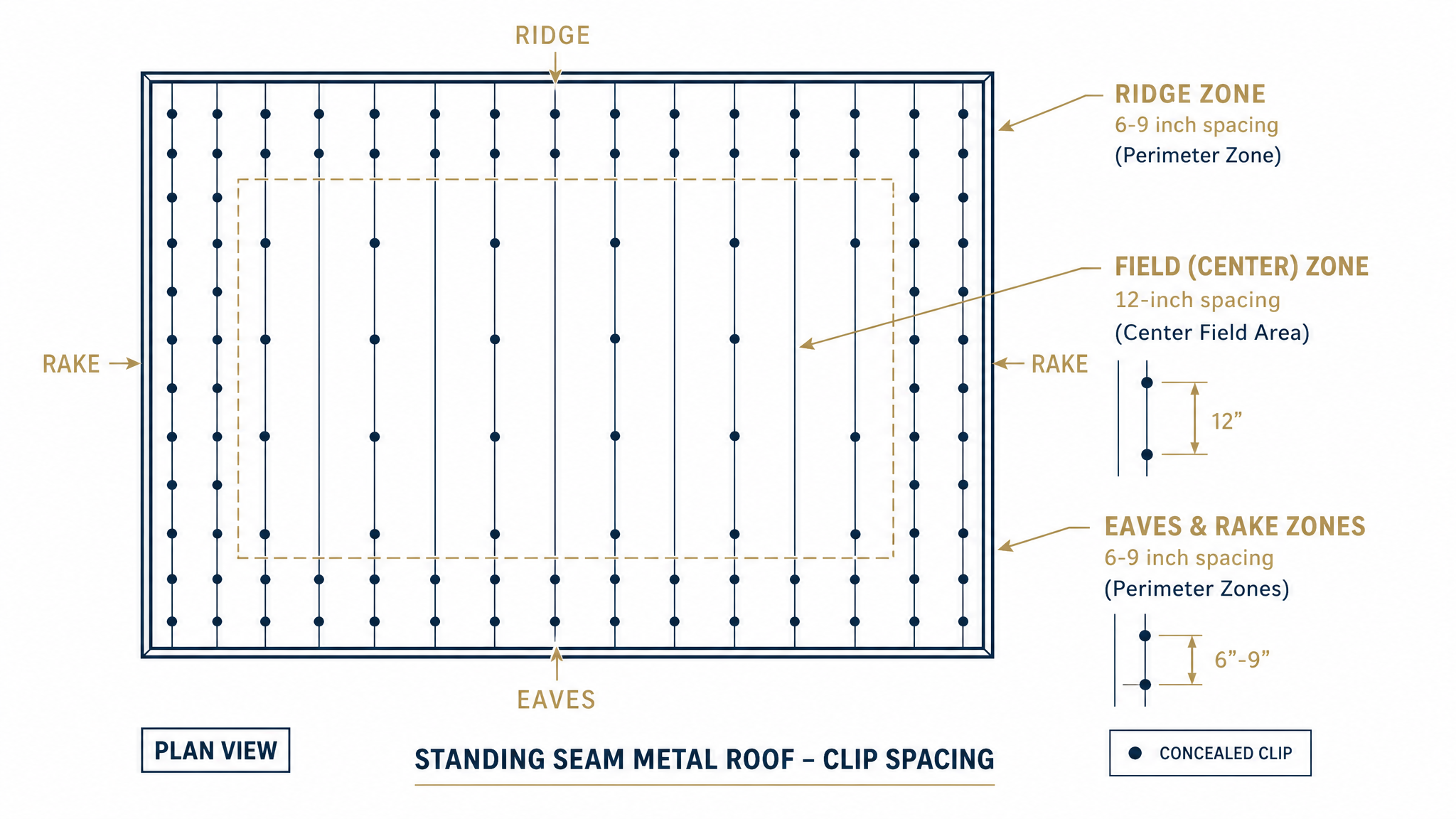
Field vs Perimeter Clip Spacing
How Do Hemmed Edges and a Continuous Cleat Resist High Wind?
A standing seam roof is strongest when the entire roof edge works as one system. We hem every panel edge and lock it onto a continuous eave cleat, so wind loads are distributed across the full perimeter instead of being concentrated on the last fastener.
Many installations simply stop at the final clip.
That means the outer edge of the roof depends on a few fasteners to resist the highest uplift forces on the building.
We build the perimeter differently.
Each panel is folded back on itself to create a hem.
That hem hooks over a continuous metal eave cleat that runs the length of the roof edge.
Instead of the last screw carrying the load, the entire hemmed edge shares it.
The benefits include:
- Greater resistance to wind uplift
- Stronger attachment along the roof perimeter
- Reduced stress on individual clips and fasteners
- A cleaner, more finished roof edge
This detail becomes especially important during Santa Ana wind events because the highest uplift pressures occur at the eaves, rakes, and corners.
Locking the panel to a continuous cleat creates a stronger connection than ending the attachment at the last clip.
Proper flashing details are equally important to keeping wind-driven rain out of the roof assembly.
Learn more:
Standing Seam Flashings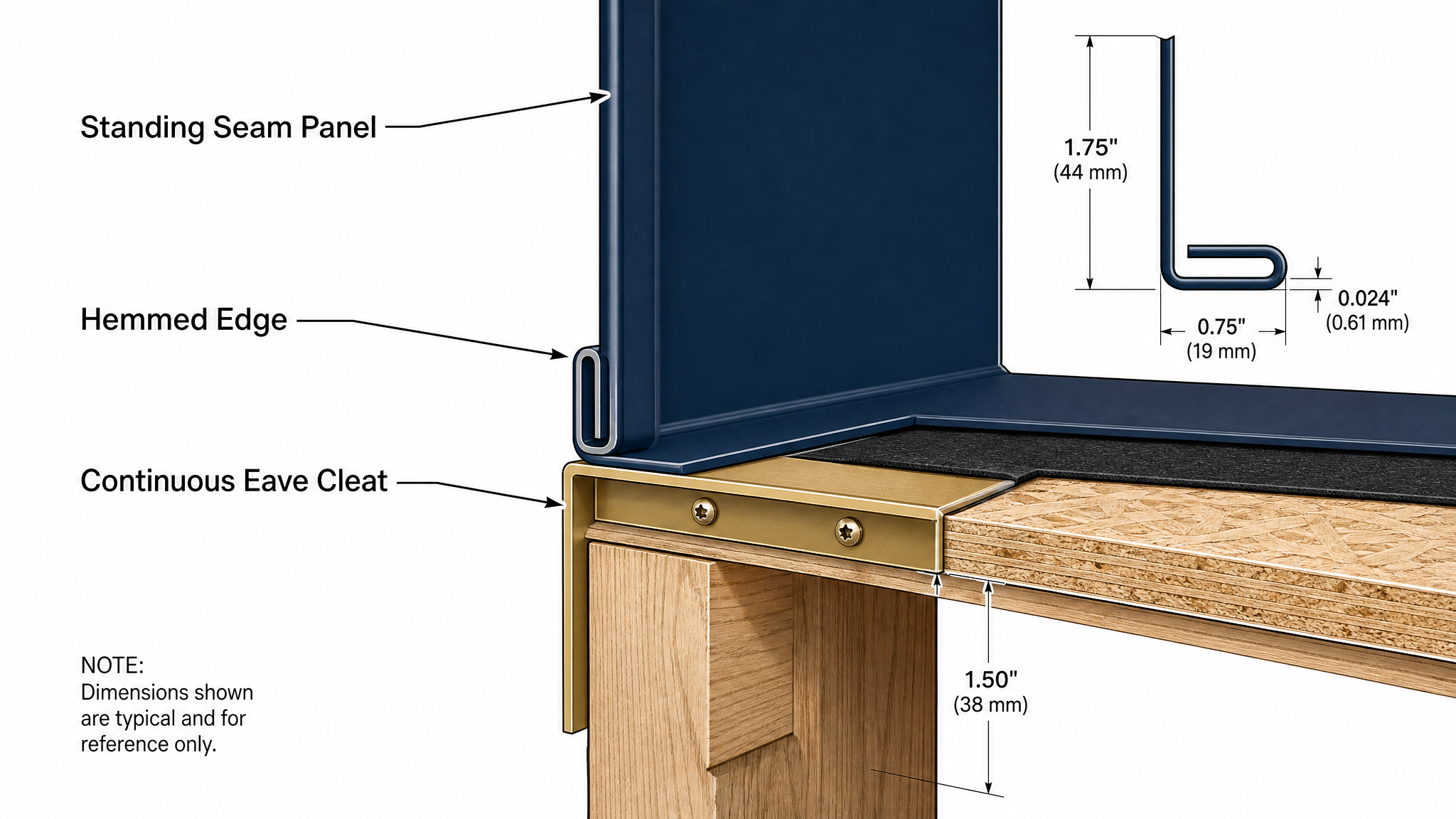
Hemmed Edge Over Continuous Eave Cleat
What Does a UL 580 Class 90 Wind Rating Require?
A high-wind roof with a proven metal roof wind rating is engineered as a complete system, not assembled from individual parts. We install 24-gauge steel as our standard and 22-gauge steel where additional rigidity is required, using roofing systems engineered to meet UL 580 Class 90 wind-uplift standards.
UL 580 is one of the roofing industry's most respected wind-uplift tests.
A Class 90 rating means the complete roof assembly has been tested to resist severe uplift forces without panel separation or structural failure.
That performance comes from the entire system working together, including:
- Panel profile
- Steel thickness
- Clip spacing
- Clip design
- Fastener attachment
- Roof deck
Each component contributes to the roof's overall wind performance.
A stronger panel alone cannot compensate for poor attachment, just as tighter clip spacing cannot overcome a weak roof assembly.
For most residential standing seam roofs, 24-gauge steel delivers the ideal combination of strength, rigidity, and long-term performance.
For homes with the greatest wind exposure, long panel runs, or low-slope roof planes, we step up to 22-gauge steel for additional stiffness.
Learn more:
24-Gauge vs 26-Gauge Metal RoofingFor the most demanding wind conditions or low-slope roof planes, we also specify a mechanical seam profile where appropriate.
Learn more:
Standing Seam Panel Profiles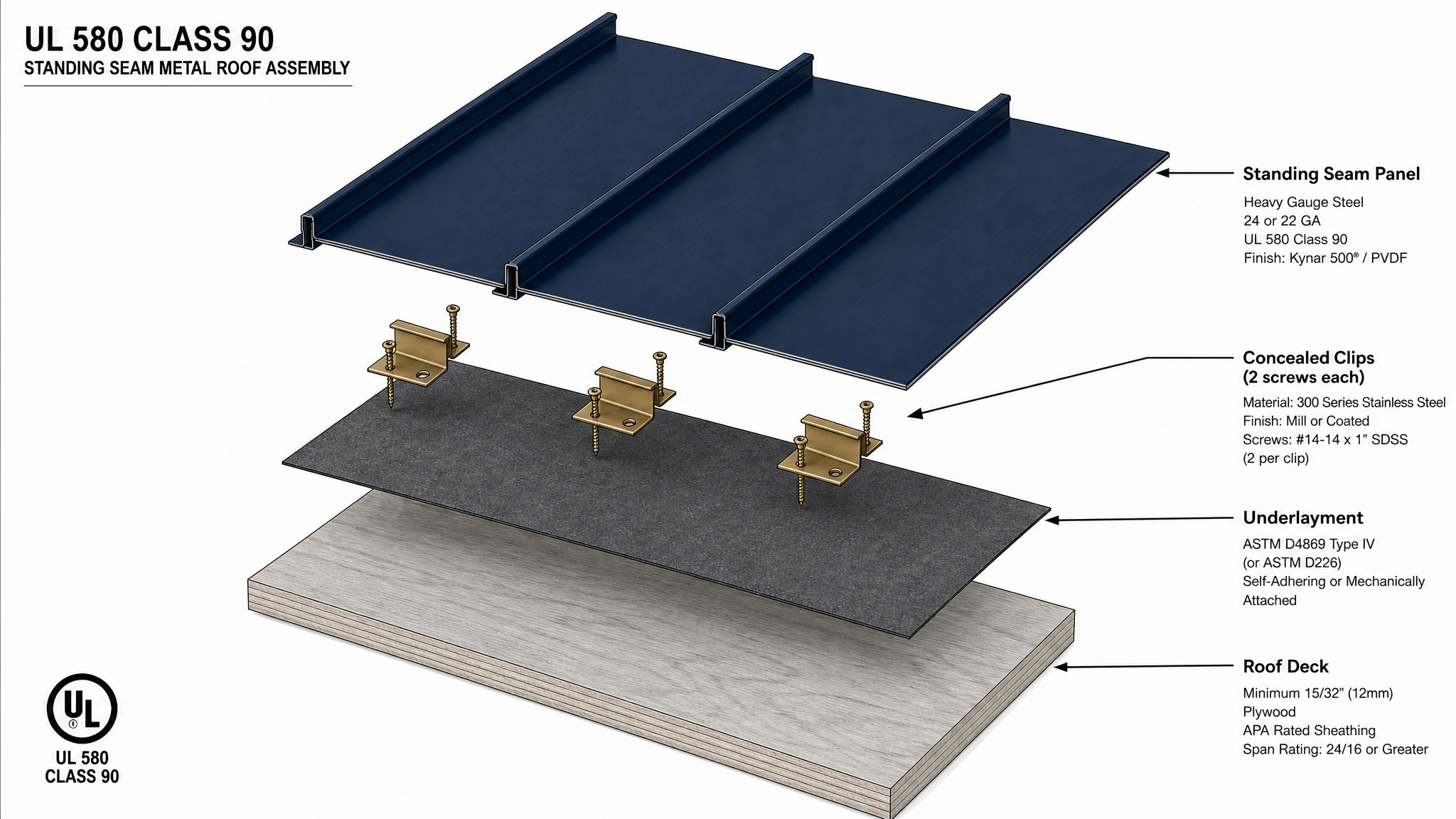
UL 580 Class 90 Standing Seam Roof Assembly
How Do Our High-Wind Specifications Compare to a Typical Install?
The difference between a roof that withstands high winds and one that fails usually comes down to installation details. The attachment system, perimeter detailing, and engineering determine how well a standing seam roof performs when Santa Ana winds begin pulling at the roof edges.
| Specification | Typical Installation | The Metal Roof Pros |
|---|---|---|
| Clip Spacing In Field | 24 Inches Common | 12 Inches |
| Clip Spacing At Eaves, Rakes & Ridges | Wider Or Uniform Spacing | 6 To 9 Inches |
| Screws Per Clip | One Fastener Common | Two Screws Per Clip |
| Roof Edge | Panel Ends At Last Clip | Hemmed Edge Locked To Continuous Eave Cleat |
| Wind Engineering | Varies By System | UL 580 Class 90 Engineered System |
Every detail in the table works together, and that combination is what carries a standing seam roof through Southern California's toughest wind conditions.
What High-Wind Conditions Does a Los Angeles Roof Face?
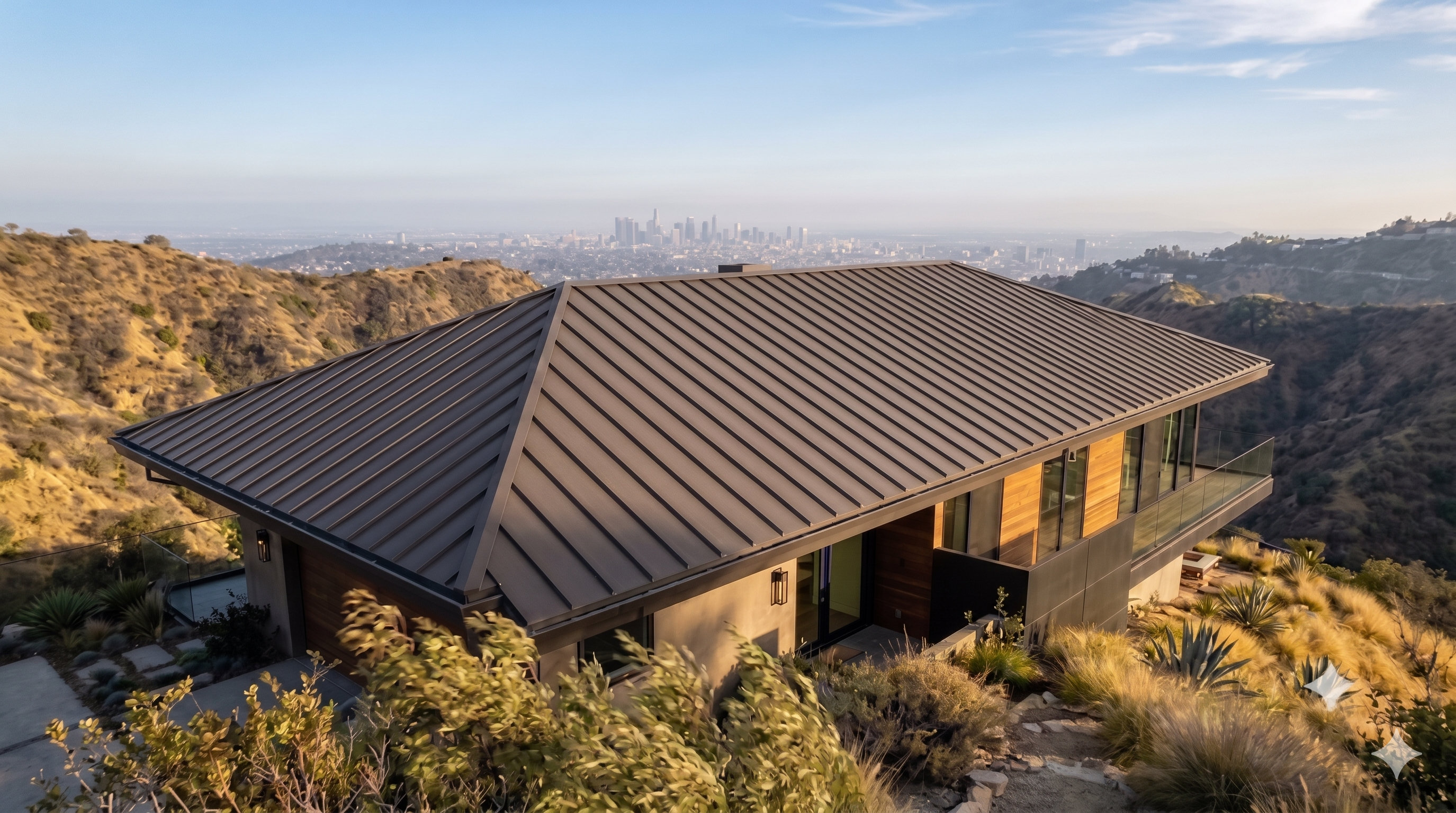
Southern California presents wind conditions that demand more than a code-minimum roof. Santa Ana winds accelerate through mountain passes and canyons, while coastal communities experience persistent onshore winds. A standing seam roof should be engineered for the environment where it will spend the next 50 years.
Homes on ridgelines, in canyon communities, and on exposed hillsides experience much greater uplift forces than homes in sheltered neighborhoods.
That is why we do not install every roof the same way.
We evaluate each home's wind exposure, roof geometry, elevation, and surrounding terrain before determining the appropriate attachment strategy.
Coastal Wind + Salt Air
For homes near the coast, wind is only part of the challenge. Salt air also influences material selection.
Coastal Aluminum RoofingA standing seam roof built for Los Angeles is engineered for the wind conditions your home actually faces, not simply the minimum required by code.
What Other Questions Should I Ask?
Get a Free Quote by Email
A high-wind roof is only as strong as the details hidden beneath the panels. We'll explain the attachment system, wind-resistant features, and engineering included in your proposal so you know exactly how your roof is built to perform.
No salesperson.
No pressure.
You're hiring the contractor other roofers hire.
Helpful Resources
CSLB #1234567 · (818) 937-4500