Attic Insulation
Fire-Resistant Attic Insulation in Los Angeles: Mineral Wool and Fiberglass
Most attic insulation is sold as an energy upgrade. In Southern California, there is another question that matters just as much: Will your insulation burn? We believe the insulation protecting your home should also help protect it from fire.
That is why we install only non-combustible attic insulation. We offer mineral wool (also called rock wool), unfaced fiberglass batts, and blown-in fiberglass. All three are fire-resistant, non-combustible, and will not burn or add fuel to a fire.
Whether you need insulation added to an existing attic or you're replacing your roof, we can install insulation as a standalone service or as part of your standing seam metal roofing project. Depending on the attic, we install batt insulation, blown-in insulation, or add new insulation over an existing layer to achieve the recommended R-value.
Better insulation keeps your home cooler during the summer, reduces heat loss during the winter, lowers energy bills, and adds another layer of protection to a fire-hardened home. We selected these materials because they deliver both thermal performance and fire resistance without compromise.
What Are the Three Fire-Resistant Attic Insulation Options?
The three insulation types we install, each non-combustible.
Mineral Wool Batts
Non-CombustibleSpun from stone and slag, the most fire-resistant insulation we install. Available as batts or blown-in.
Unfaced Fiberglass Batts
Non-CombustibleNon-combustible glass fibers with no kraft paper facing, ideal for open, accessible attic framing.
Blown-In Fiberglass
Non-CombustibleLoose-fill insulation distributed evenly across the attic floor for complete, gap-free coverage.
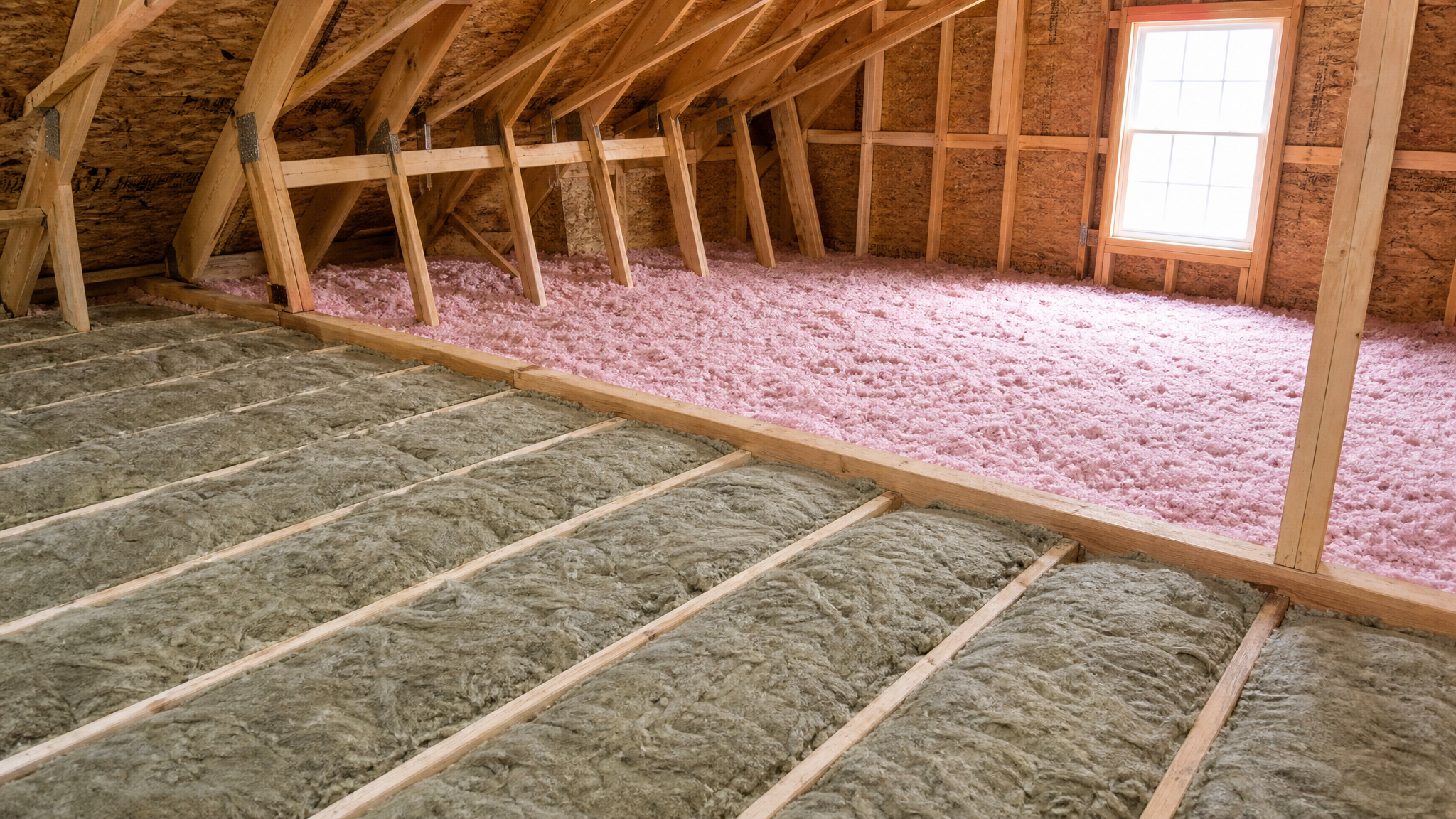
Comparison of mineral wool, unfaced fiberglass batt insulation, and blown-in fiberglass attic insulation.
What Attic Insulation Do We Install?
We install three types of attic insulation, and all three are non-combustible. Mineral wool, unfaced fiberglass batts, and blown-in fiberglass will not burn or add fuel to a fire. We recommend the right material and installation method based on the design of your attic.
Mineral Wool (Rock Wool)
Mineral wool, also called rock wool, is the most fire-resistant insulation we install. It is made by spinning stone and slag into mineral fibers, creating insulation that withstands extremely high temperatures without burning.
A common misconception is that mineral wool contains asbestos. It does not. Mineral wool is an entirely different product made from spun mineral fibers.
We install mineral wool as batts or blown-in insulation, depending on the attic and the application.
Unfaced Fiberglass Batts
Fiberglass batt insulation is made from non-combustible glass fibers. We install unfaced batts, meaning there is no kraft paper or paper facing that could burn.
Batt insulation is an excellent choice for attics with open, accessible framing where the insulation can be installed cleanly between ceiling joists.
Blown-In Fiberglass
Blown-in fiberglass is a loose-fill insulation installed with specialized equipment that distributes the material evenly across the attic floor.
Because it flows around framing members and into difficult-to-reach spaces, blown-in fiberglass provides complete, even coverage while filling gaps that batt insulation cannot always reach.
Batts or Blown-In?
The best installation method depends on the attic.
For open, unobstructed attics, batt insulation provides a clean, organized installation.
For attics with numerous obstructions, irregular framing, or existing insulation that needs to be supplemented, blown-in fiberglass often delivers the most complete coverage.
Whether we're insulating a brand-new attic or adding insulation to an existing home, we'll recommend the installation method that produces the best finished result while achieving the proper insulation level for your home.
What Does a Radiant Barrier Add to Attic Insulation?
A radiant barrier is a reflective aluminum layer that reflects the sun's radiant heat away from your attic before it can soak in, and it pairs perfectly with non-combustible insulation. On hot Southern California days, it helps lower your cooling costs by keeping the attic and the rooms below cooler. Because it is aluminum, it is non-combustible and adds no fuel to a fire, so it holds to the same fire-safe standard as everything else we install.
How Do We Remove Old Attic Insulation Without a Mess?
Removing old attic insulation is where the real risk lives, both to your health and to your home. Older attic insulation can hold asbestos, rodent droppings, and decades of fine dust, none of which should ever drift into your living space. So before we pull out a single inch, we turn your home into a sealed, protected worksite.
We seal off the entire path. We build plastic containment on ZipWall barriers from the attic hatch all the way to the entry, cover your floors and walls, and seal every room we pass. Your furniture, photos, and finishes stay protected from start to finish.
We vacuum it straight out of the house. A powerful hose-and-vacuum system pulls the old insulation out of the attic and sends it through a sealed line into a collection bag outside. The old material, and anything hiding in it, leaves your home without ever touching your living space.
We leave it cleaner than we found it. When the removal is done, we take down the containment, haul everything away, and the only sign we were there is a cleaner, safer attic ready for new fire-resistant insulation.
Our containment and insulation-removal process on a West Hills home.
The care you see in this setup is the part of the job you probably never thought about, and it is exactly where a quality insulation contractor separates from the rest.
Mineral Wool vs. Fiberglass: Which Is Better?
Both are excellent, non-combustible attic insulation materials. They deliver similar thermal performance at roughly R-3 per inch. The best choice depends on your attic, your priorities, and your budget.
Mineral Wool
Mineral wool is the premium option for homeowners who place the highest value on fire resistance. Because it is made from spun stone and slag, it withstands extremely high temperatures without burning, making it the most fire-resistant insulation we install.
Mineral wool is also denser than fiberglass, which helps it fit snugly between framing members while providing the solid, high-quality feel many homeowners prefer.
It is available as both batt insulation and blown-in insulation, allowing it to be used in a variety of attic configurations.
Fiberglass
Fiberglass insulation is also non-combustible and provides nearly the same thermal performance per inch as mineral wool.
It is available as unfaced batts for open attics and blown-in fiberglass for complete, even coverage across the attic floor. Because blown-in fiberglass flows into corners, around framing, and into hard-to-reach spaces, it is often the best solution for existing homes.
Fiberglass also costs less than mineral wool, making it an outstanding value while still providing excellent fire resistance and energy efficiency.
Which One Should You Choose?
There is no wrong choice because both materials are non-combustible and both provide excellent insulation performance.
If maximum fire resistance is your highest priority, mineral wool is our premium recommendation.
If you're looking for outstanding performance, complete attic coverage, and lower cost, fiberglass is an excellent choice.
We'll inspect your attic, explain the advantages of each option, and recommend the insulation that best matches your home, your goals, and your budget.
What R-Value Do You Need in a Los Angeles Attic?
For most Los Angeles homes, we recommend insulating to R-38. That is the level California Title 24 requires and the U.S. Department of Energy recommends for our climate, which generally falls within an R-30 to R-49 range depending on the home.
What Is an R-Value?
An R-value measures how well insulation resists the flow of heat. The higher the R-value, the more effectively the insulation slows heat transfer between your attic and the living space below.
Better insulation helps keep your home cooler during hot Southern California summers, reduces heat loss during cooler months, and lowers the workload on your heating and air conditioning system.
How Thick Is R-38?
For most insulation materials, R-38 is approximately 12 to 15 inches thick, depending on the product installed.
Both mineral wool and fiberglass provide roughly R-3 per inch, allowing either material to achieve the recommended insulation level with similar overall thickness.
We Insulate to the Right R-Value for Your Home
Not every attic starts at the same place. Some homes have little or no insulation, while others simply need additional insulation added over the existing layer.
We evaluate your attic, determine the current insulation level, and install the amount needed to reach the appropriate R-value for your home.
The result is an attic that performs the way it should, helping keep your home more comfortable year-round while reducing energy consumption and cooling costs.
Why Do We Only Install Non-Combustible Attic Insulation?
We install only non-combustible attic insulation because it continues protecting your home even if embers reach the attic. That is why our insulation options are limited to mineral wool, unfaced fiberglass batts, and blown-in fiberglass.
We do not install spray foam insulation. Spray foam is a petroleum-based plastic, making it a combustible material.
We also do not install cellulose insulation. Although it is treated with fire retardants, cellulose is made from recycled paper, making it a combustible product.
During a wildfire, wind-driven embers can enter an attic through vulnerable openings. Combustible insulation can become additional fuel inside the attic. Non-combustible insulation does not ignite or add fuel to a fire.
That difference is why we made a deliberate decision about the insulation products we offer. Rather than installing every type of insulation on the market, we focus exclusively on materials that deliver excellent thermal performance while remaining non-combustible.
Learn more:
Wildfire ProtectionHow Does Attic Insulation Fit Into a Fire-Hardened Home?
Fire-resistant attic insulation is one part of a complete fire-hardening strategy. The best protection comes from combining multiple non-combustible materials that work together to reduce the ways fire and embers can threaten your home.
The first layer is non-combustible attic insulation. Mineral wool, unfaced fiberglass batts, and blown-in fiberglass help insulate your home without adding fuel if embers ever reach the attic.
The second layer is ember-resistant Vulcan Vents. They allow your attic to ventilate normally every day, then swell shut in a fire, helping block embers, flames, and heat from entering through one of the home's most vulnerable openings.
Learn more:
Vulcan VentsThe third layer is Polyglass Polystick XFR, our fire-resistant, self-adhered underlayment installed beneath every standing seam roof. It provides another level of protection as part of the complete roofing assembly.
Learn more:
Polyglass Polystick XFR UnderlaymentTogether, these materials contribute to a Class A fire-rated roofing assembly, while proper attic ventilation helps control heat and moisture year-round.
Learn more:
What Does Fire-Resistant Attic Insulation Cost?
A full remove-and-replace runs about $3 to $5 per square foot for batts and $7 to $9 per square foot for blown-in. That price includes sealing off your home, removing and hauling away the old insulation, and installing new non-combustible material to the right R-value. Because you work with us directly, there is no middleman markup on the job. Every attic is different, so we give you a detailed written quote with an exact price, and there is no site visit until you are ready.
What Other Questions Should I Ask?
Reviews
What Do Our Clients Say?

Susan M.
Calabasas, CA
The Metal Roof Pros installed a dark bronze standing seam on our home and it completely transformed the exterior. Their crew was detail-oriented and left the property spotless every day. The finished roof is a showpiece. We get compliments from neighbors constantly.

Michael T.
Thousand Oaks, CA
After getting five quotes from different companies, The Metal Roof Pros were the only team who could explain their gauge, clip spacing, and underlayment system in detail. Their knowledge of standing seam installation is unmatched. The roof looks and performs flawlessly.

Jennifer L.
Encino, CA
We hired The Metal Roof Pros for a charcoal gray Kynar 500 standing seam roof. Karen walked us through every color option and helped us choose the perfect shade to match our stone facade. The color is exactly what we wanted and the finish is stunning.

David R.
Malibu, CA
Living on the coast, we needed a roof that could handle salt air. The Metal Roof Pros recommended their aluminum standing seam system and explained exactly why steel would not work at our location. Two years later, zero corrosion issues. Worth every penny.

Patricia W.
Pacific Palisades, CA
After the 2024 wildfires, we prioritized fire protection for our rebuild. The Metal Roof Pros installed a Class A rated standing seam system with proper ember-resistant detailing at every penetration point. Our insurance company was very impressed with the fire rating documentation.

Robert K.
Agoura Hills, CA
We own a commercial property in Agoura Hills and needed a reliable roofing contractor. The Metal Roof Pros handled our 12,000 square foot standing seam installation on schedule and on budget. Their commercial crew was professional and incredibly efficient.

Maria G.
Sherman Oaks, CA
Karen and the entire Metal Roof Pros team made the process simple from estimate to final walkthrough. They installed seamless rain gutters to match our new metal roof and the integration between the two systems is perfect. Everything drains exactly where it should.

James H.
Beverly Hills, CA
We had The Metal Roof Pros install a 22-gauge standing seam on our hillside property. The heavier gauge was recommended for the wind exposure and steep pitch. The installation quality is exceptional. Every panel, clip, and flashing is precise.

Linda C.
Woodland Hills, CA
The attic ventilation work The Metal Roof Pros did alongside our standing seam installation made a huge difference in our cooling costs. They installed ridge vents and balanced the intake system properly. Our upstairs rooms are noticeably cooler in summer.

Carlos A.
Pasadena, CA
The Metal Roof Pros replaced our old tile roof with a matte black standing seam and it completely modernized our 1960s ranch home. The crew handled the tear-off and new installation in under a week. Clean work, great communication, outstanding result.

Sarah P.
Studio City, CA
We added new rain gutters when The Metal Roof Pros installed our standing seam roof. They color-matched the gutters to the roof panels perfectly. The seamless gutter system handles our heaviest rains without any overflow issues. Excellent craftsmanship throughout.

Thomas B.
Westlake Village, CA
As a retired general contractor, I am extremely particular about installation quality. The Metal Roof Pros exceeded my expectations. Their clip spacing, flashing details, and underlayment application were textbook perfect. This is how metal roofing should be done.

Angela D.
Brentwood, CA
We chose a slate blue Kynar 500 finish and it looks absolutely beautiful on our contemporary home. The Metal Roof Pros helped us visualize the color with actual panel samples before we committed. The 35-year paint warranty gave us total confidence in the investment.

Mark S.
Northridge, CA
Our commercial building needed a complete re-roof and The Metal Roof Pros delivered a standing seam system that solved our persistent leak problems. Their attention to flashing details around our HVAC units and skylights was impressive. No leaks since installation.

Diane F.
Topanga, CA
Living in a Very High Fire Hazard Severity Zone, our insurance required a noncombustible roof. The Metal Roof Pros installed a Class A rated standing seam system that satisfied every code requirement. Our premium dropped significantly after we submitted the documentation.
Susan M.
Calabasas, CA
The Metal Roof Pros also handled our attic insulation upgrade when they installed the metal roof. The combination of reflective metal panels and proper insulation cut our summer energy bill by about 20%. The house stays cooler without running the AC as hard.
Robert K.
Agoura Hills, CA
We brought The Metal Roof Pros back for a second commercial project because the first installation was flawless. They understand the unique demands of commercial roofing, including foot traffic paths, equipment mounting, and drainage slopes. Highly recommended for any commercial job.
Maria G.
Sherman Oaks, CA
Our home is near the coast and The Metal Roof Pros recommended aluminum panels instead of steel for our location. The aluminum standing seam system has held up perfectly against the salt air. No corrosion, no discoloration, and the warranty covers us for decades.
James H.
Beverly Hills, CA
The gutter installation by The Metal Roof Pros was just as impressive as the roof work. They used 6-inch seamless aluminum gutters with hidden hangers, and the downspout routing was carefully planned to keep our landscaping protected. Outstanding detail work.
Jennifer L.
Encino, CA
When it came to fire hardening our property, The Metal Roof Pros provided a complete assessment. They installed a noncombustible standing seam roof and sealed every vent and soffit with ember-resistant materials. Our home now meets the latest California wildfire building codes.
Get a Free Quote
Whether you're upgrading the insulation in an existing home or building a new one, getting a quote is simple.
- For existing homes: we measure your roof using high-resolution satellite imagery and email you a detailed written quote with our insulation recommendations, the recommended R-value, material options, and project cost.
- For new construction: simply upload your architectural plans, and we'll prepare your insulation quote directly from your drawings.
There is no site visit until you're ready, no sales calls, and no pressure. You receive the information you need to compare your options and move forward when the time is right.
You are hiring the contractor other roofing contractors hire.
We require separate first name, last name, and detailed property address fields to pull accurate 3D satellite measurements remotely and send your guaranteed wholesale price quote directly to your inbox.
CSLB #1234567
C-39 Roofing Contractor
C-43 Sheet Metal Contractor
Class B General Contractor
C-10 Electrical Contractor