Home Fire Hardening Services for Southern California
Most homes lost during wildfires are ignited by wind-driven embers. Those embers blow through roof and attic vents into the attic, where they ignite insulation, framing, and stored belongings and set the home on fire from the inside, often while flames are still far from the neighborhood. The roof and attic are where most of those embers get in, so that is where we focus.
Learn more about our complete wildfire services: Wildfire Protection
What Is Home Hardening?
Home hardening is the process of making your home more resistant to wildfire embers and radiant heat. The roof and attic are the highest priorities because wind-driven embers blow through vents into the attic, where they can ignite insulation, framing, and stored belongings, setting the home on fire from the inside.
CAL FIRE's home-hardening guidance focuses on closing the pathways embers use to get into a house. That means treating your home as a complete system instead of relying on a single product or material.
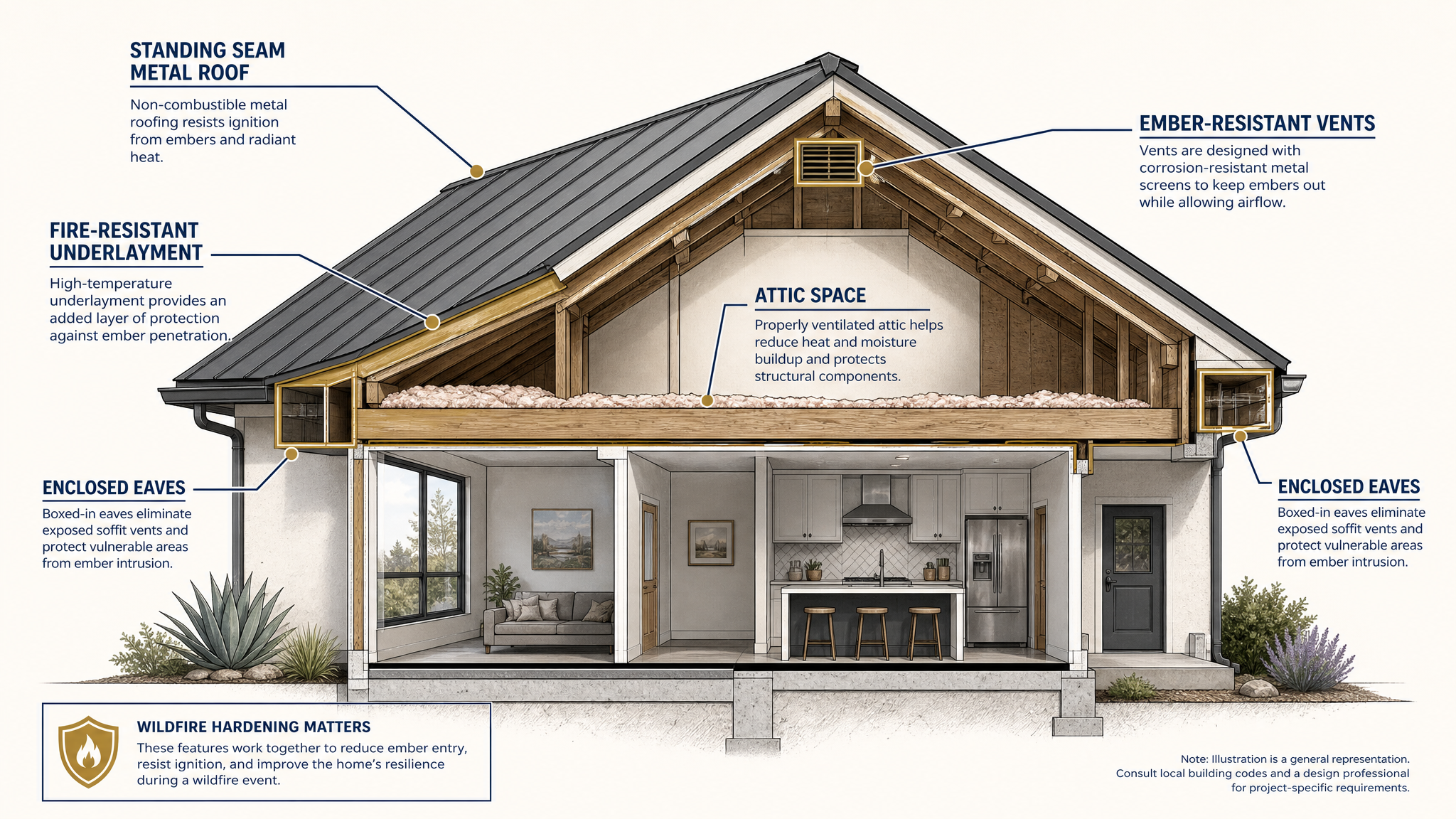
We focus on the roof, attic, and eaves. We combine a Class A standing seam metal roof, fire-resistant underlayment, ember-resistant roof vents, and properly enclosed eaves into one integrated roofing system that helps reduce the opportunities for embers to enter your home.
Where Does Fire Hardening Start? At the Roof.
Wildfire protection starts at the roof because it is the largest surface exposed to wind-driven embers. A Class A standing seam metal roof combined with Polyglass Polystick XFR fire-resistant underlayment creates the foundation of a roof designed to resist ember intrusion.
A standing seam metal roof provides a durable, non-combustible outer layer that will not ignite when embers land on it. Beneath the panels, Polyglass Polystick XFR adds another layer of protection directly over the roof deck with a fire-resistant underlayment engineered for metal roofing systems.
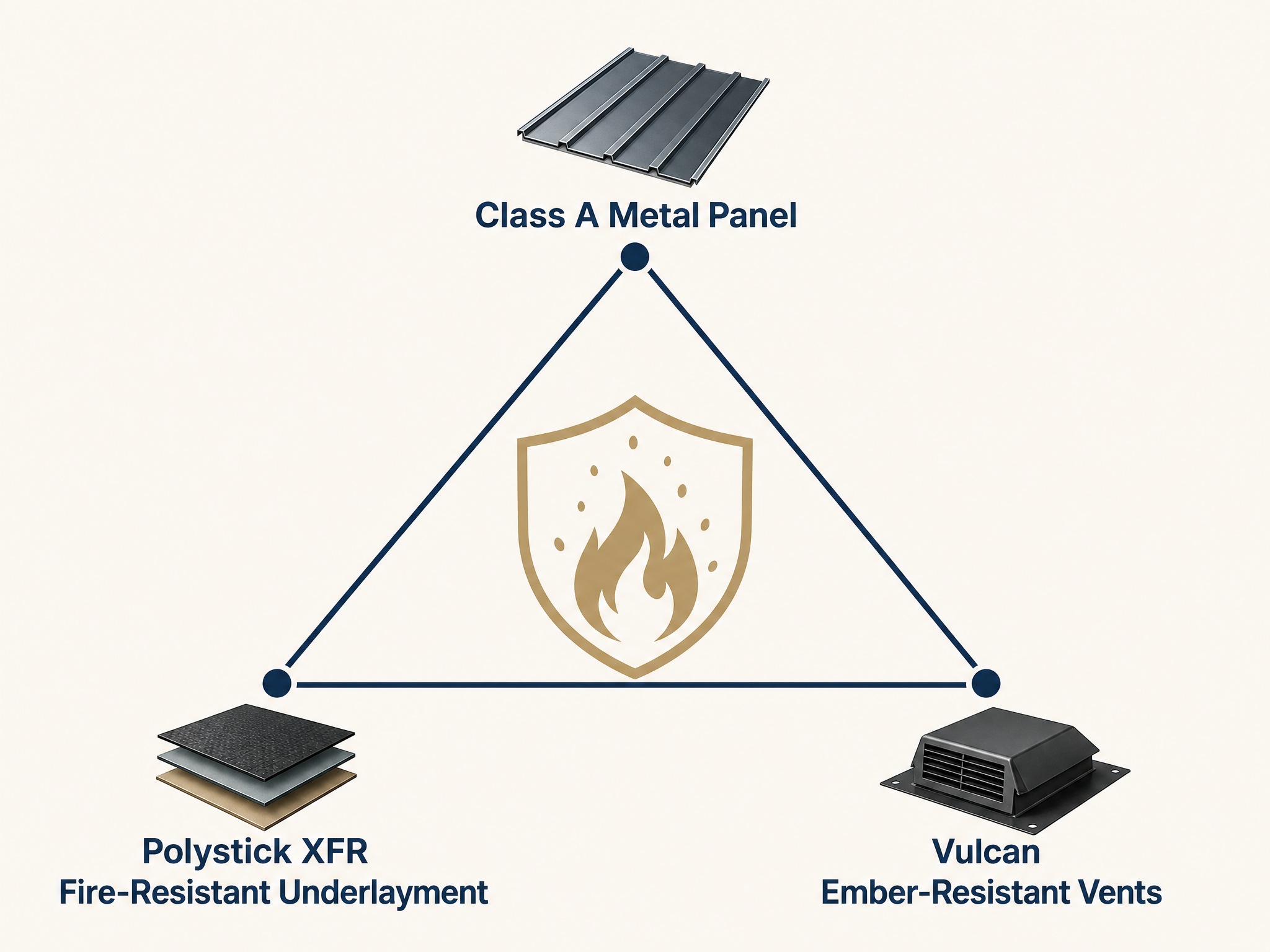
Three components do the real work against embers, and we build all three into every wildfire roof. A Class A standing seam metal panel gives embers a non-combustible surface they cannot ignite. Polyglass Polystick XFR fire-resistant underlayment puts a fire-resistant layer directly over the roof deck. And California State Fire Marshal-listed Vulcan ember-resistant vents keep embers from being pulled into the attic. Each one closes a different path an ember can take, and together they form a trio that protects the roof, the deck, and the attic as one system.
Beyond those three core layers, we add enclosed eaves and carefully detailed flashing to further reduce the pathways embers use to enter the home.
What Parts of Your Home Do We Fire Harden?
We harden the parts of your home where wildfire embers are most likely to enter. Each component plays a specific role in reducing ember intrusion while working together as one integrated roofing system.
Ember-Resistant Roof Vents
We install California State Fire Marshal-listed ember-resistant roof vents, with Vulcan as our default choice for standing seam metal roofs. These vents maintain proper attic ventilation while helping block wind-driven embers from blowing into the attic, where they could ignite insulation and framing.
Ember-Resistant Roof VentsEave and Soffit Enclosure
Open eaves can trap wind-driven embers beneath the roof edge, where they can ignite exposed wood framing. We enclose eaves using non-combustible metal, stucco, or fiber-cement (Hardie) so embers have fewer places to collect or ignite combustible materials. Properly enclosed eaves are one of the most effective improvements you can make to a wildfire-resistant roof. For homes going the metal route, see our dedicated metal eave enclosure service for the full detail.
Attic Insulation
Quality attic insulation helps regulate temperature year-round and adds another layer within the roof assembly. During a roof replacement, we can evaluate your existing insulation and recommend upgrades when appropriate.
Attic InsulationGable Attic Fans
Proper attic ventilation remains essential, even in wildfire country. Where appropriate, gable attic fans can improve attic airflow as part of a complete ventilation strategy. They work together with intake and exhaust ventilation to help maintain a healthier attic environment.
Attic Ventilation & Attic FansWhat Else Goes Into Hardening a Home Against Wildfire?
Home hardening extends beyond the roof. Windows, siding, decks, fences, and defensible space all contribute to a home's ability to withstand a wildfire. We specialize in the roof, attic, and eaves because they are among the most common pathways for wind-driven embers.
Creating a wildfire-resistant home is about combining multiple layers of protection. A fire-resistant roof system works best when it is paired with well-maintained defensible space, ember-resistant construction details, and proper exterior materials throughout the property.
For vegetation management and defensible space recommendations, we encourage homeowners to follow CAL FIRE's guidance.
Our role is to make sure the roof and attic are built with the same attention to detail as every other part of your roofing system.
Why The Metal Roof Pros for Fire Hardening?
We specialize in standing seam metal roofing, and we build every wildfire protection detail into the roofing system from the start. Our goal is simple: create a roof and attic assembly that leaves embers with as few opportunities as possible to enter your home.
Our C-43 sheet-metal specialist hand-fabricates the flashings, vent transitions, and eave details on site so every component fits the roof precisely. That creates a cleaner, more weathertight installation where the roofing panels, ember-resistant vents, flashings, and eaves all work together.
Our complete license stack includes C-39 Roofing, C-43 Sheet Metal, Class B General Contractor, and C-10 Electrical, allowing us to perform the work needed to integrate roofing, sheet metal, and ventilation into one coordinated system.
We are meticulous about every layer because wildfire protection is achieved through the entire roof assembly, not by relying on a single product.
Standing Seam Metal Roof InstallationDo You Need to Harden Your Home in Southern California?
If your home is in a Wildland-Urban Interface (WUI) or other designated high-fire area, home hardening is an important part of protecting your property from wildfire. Many homes in these areas are also subject to California Chapter 7A building requirements for wildfire-resistant construction.
Southern California's dry climate, steep terrain, and seasonal winds create conditions where embers can travel long distances ahead of an active wildfire. Strengthening the roof, attic, and eaves helps reduce the pathways those embers use to enter a home.
We provide roof and attic fire hardening services throughout Los Angeles, Orange, Ventura, and Riverside counties, combining a Class A standing seam metal roof, fire-resistant underlayment, ember-resistant vents, and carefully detailed eaves into one integrated system designed for Southern California conditions.
Get a Free Quote
Getting your quote is simple, with no pushy salesperson. For an existing home we measure your roof from high-resolution satellite imagery and email you a detailed written quote; for new construction, upload your architectural plans and we will prepare your quote from those. Either way, we include a roof and attic fire-hardening assessment with your detailed written quote.
No site visit until you're ready.
No sales calls.
No pressure.
You're hiring the contractor other roofers hire.
(818) 937-4500