Ember-Resistant Roof Vents for Los Angeles Standing Seam Metal Roofs
Wildfires destroy homes with embers long before flames arrive. Those embers can enter through ordinary roof vents and land on the roof deck inside the attic. We build every standing seam metal roof as a layered wildfire defense: a non-combustible Class A metal roof panel on top, Polyglass Polystick XFR fire-resistant underlayment beneath it, and California State Fire Marshal-listed ember-resistant roof vents, with Vulcan as our default choice. Every layer works together so an ember has nowhere to go.
Why Does a Roof Need Vents at All?
A roof needs vents to let heat and moisture escape from the attic. When intake vents at the soffits work together with exhaust vents at the roof, they create continuous airflow that pulls hot, moist air out, keeping the attic cooler in summer, drier in winter, and helping protect the roof.
Think of it like opening the windows in your house. Open one window and you get a little air movement. Open another window on the opposite side and you create a strong cross breeze. That is exactly how a properly ventilated attic works. Soffit vents down low pull cooler air in while roof vents up high let hot air out. Together, they create a natural flow that removes heat and moisture.
Many homeowners think roof vents let cold air into the attic during winter and hot air into the attic during summer. The opposite is true. A balanced intake-and-exhaust system moves hot, moist air out. In summer, it flushes trapped attic heat that can exceed 150 degrees. In winter, it carries away moisture before it can condense on the roof deck and lead to rot.
Because your attic needs that airflow, sealing the vents shut is not the answer in wildfire country. The answer is ember-resistant vents that maintain proper attic ventilation while helping block wind-driven embers from entering the attic.
How Do Embers Get Into Your Home Through Roof Vents?
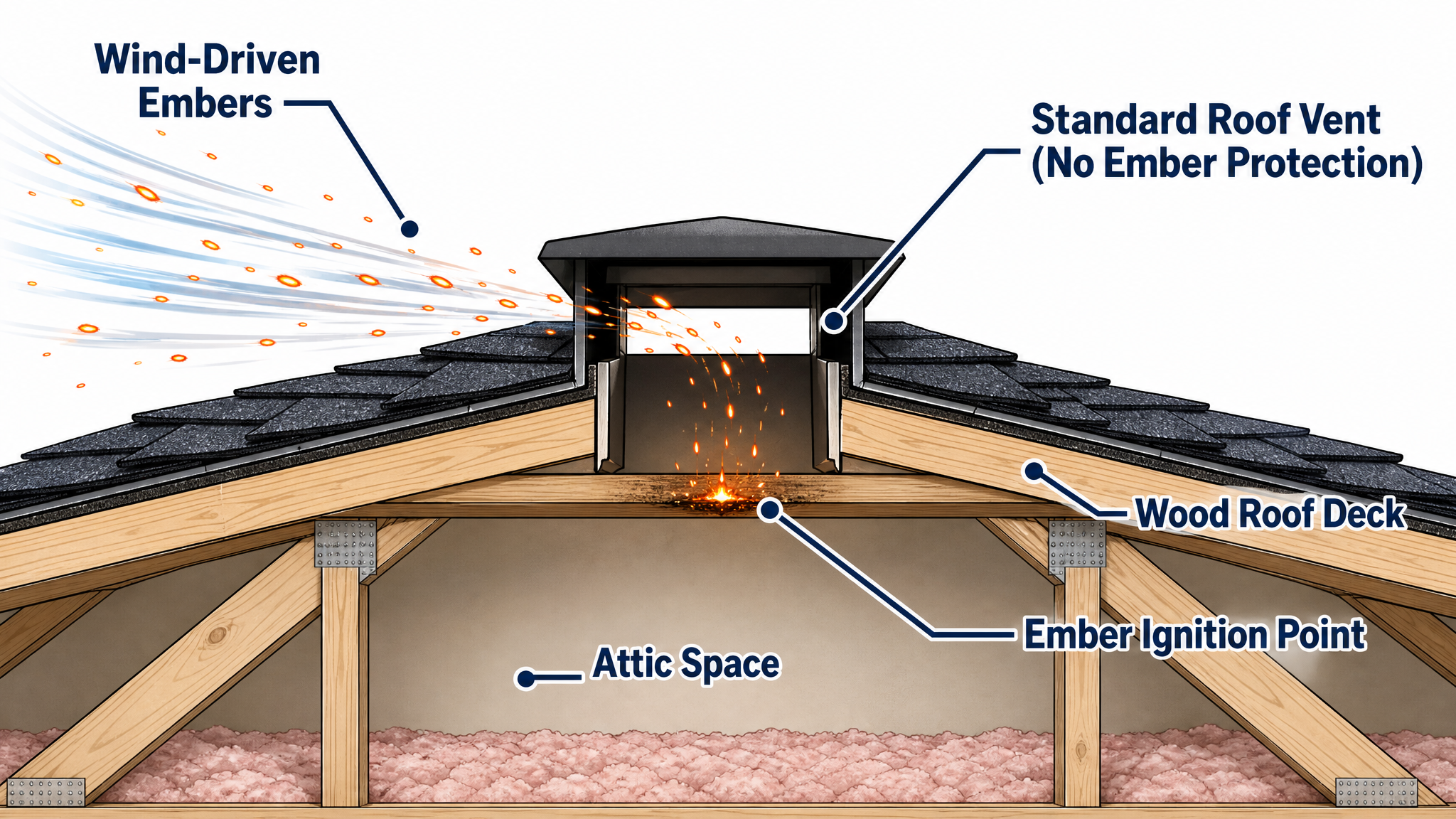
Most homes lost to wildfire are not set on fire by flames reaching the house. They are ignited by wind-blown embers, which fire agencies like CAL FIRE identify as the leading cause of home loss in wildfires. Embers can travel from a fire blocks or even miles away, ride the wind into ordinary roof vents, and land on the roof deck inside the attic, starting a fire from the inside while flames are still far from the neighborhood.
Most people picture a wildfire reaching the house with flames.
In reality, embers are often the first threat to arrive. Strong winds carry burning embers through neighborhoods, where they look for openings in the building envelope.
Ordinary roof vents are designed to move air, not stop embers.
Once an ember passes through a standard vent, it can land on the roof deck or other combustible materials inside the attic. If conditions are right, that single ember can start a fire inside the home while the wildfire is still hundreds of yards away.
That is why ember-resistant roof vents have become a critical part of wildfire-resistant construction in Southern California.
They are designed to maintain attic ventilation while helping prevent wind-driven embers from entering the attic in the first place.
How Do the Panel, Underlayment and Vents Work Together Against Embers?
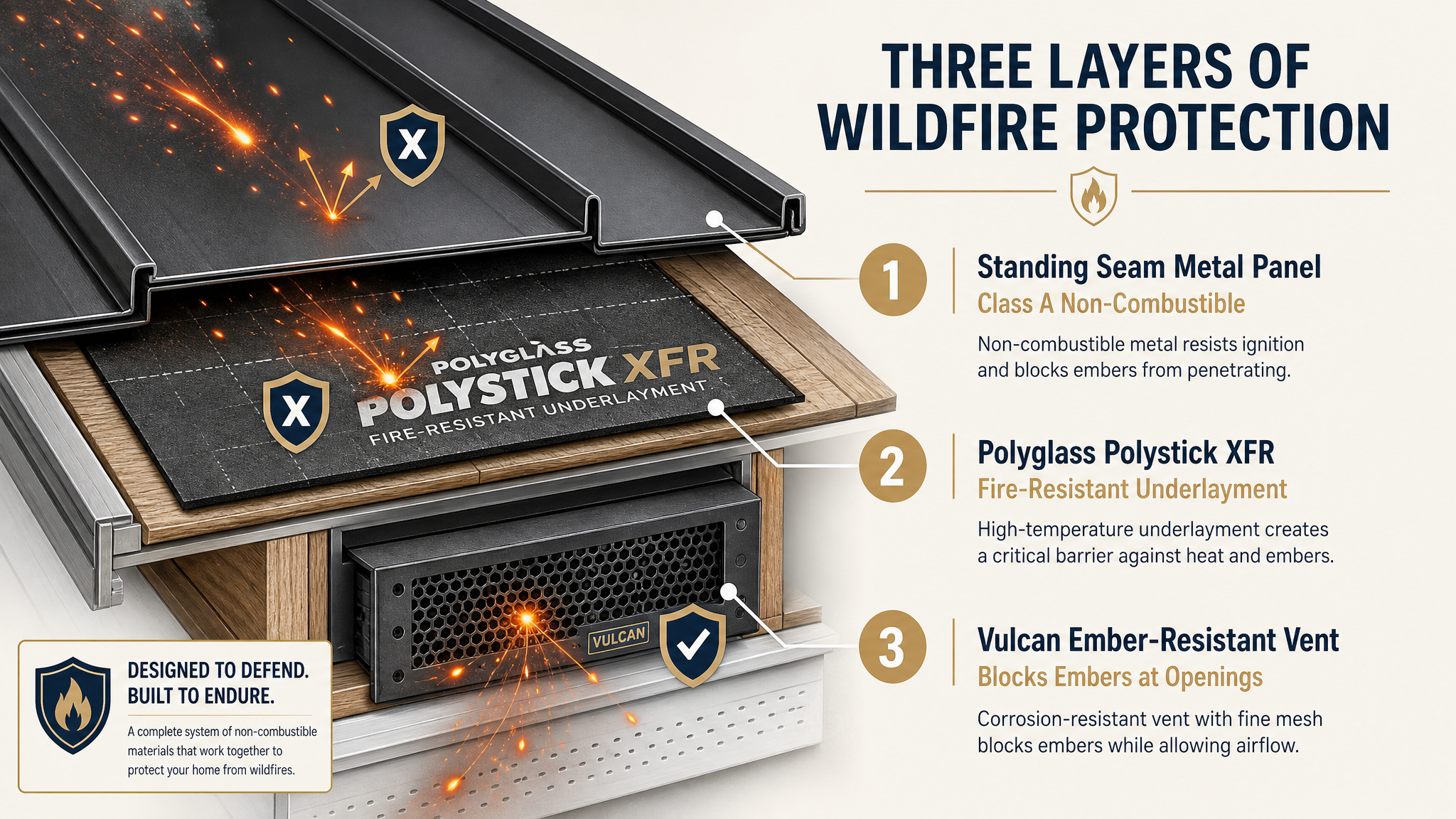
A wildfire-resistant roof depends on layers working together. We build every standing seam roof with a Class A metal roof panel, Polyglass Polystick XFR fire-resistant underlayment, and California State Fire Marshal-listed ember-resistant vents. If an ember gets past one layer, the next layer is already there waiting.
Most roofing systems focus on the roof covering.
We engineer the entire roofing assembly.
The first layer is the non-combustible Class A standing seam metal roof panel. Burning embers cannot ignite the metal itself, giving them fewer places to gain a foothold on the roof surface.
Beneath the metal, we install Polyglass Polystick XFR, a premium high-temperature underlayment designed specifically for metal roofing. It provides a fire-resistant layer directly over the roof deck, so if an ember ever gets beneath the metal roof or slips past a vent opening, it lands on a fire-resistant membrane instead of exposed wood.
The final layer is a system of California State Fire Marshal-listed ember-resistant vents installed wherever the roof requires ventilation. We typically specify Vulcan ember-resistant vents because they provide exceptional wildfire protection while maintaining proper attic ventilation.
Every layer has a different job.
- The metal roof panel sheds weather and provides a non-combustible exterior surface.
- Polyglass Polystick XFR protects the roof deck with a fire-resistant underlayment.
- Ember-resistant vents help stop burning embers from entering the attic.
That layered approach creates a stronger wildfire defense than relying on the roofing panels alone.
What Are Ember-Resistant (WUI) Vents?
Ember-resistant vents are attic vents engineered to let air flow while blocking burning embers and flame from entering the attic. They are tested to ASTM E2886, the ember-intrusion standard, and listed for use in California's Wildland-Urban Interface (WUI) Chapter 7A fire areas.
They work using a combination of fine non-combustible mesh, internal baffles, and, on the strongest models, heat-activated intumescent material that expands to seal the vent under extreme heat. Day to day, they ventilate the attic like any vent. During a wildfire, those features keep wind-driven embers and flame out.
On your roof, this is the layer that protects the openings, working together with the non-combustible metal panel above and the fire-resistant underlayment on the deck.
Which Ember-Resistant Vent Is Best? Vulcan vs BrandGuard vs FireShield
All four manufacturers produce high-quality ember-resistant vents listed for California wildfire applications. We default to Vulcan on our standing seam metal roofs because it integrates exceptionally well with ridge ventilation and combines ember resistance with heat-activated fire protection. When a project calls for a different listed product, we specify the vent that best fits the roofing system.
| Vent | Listed | Standing Seam Fit | What Sets It Apart |
|---|---|---|---|
| Vulcan (Our Default) | California State Fire Marshal (BML 8165), ASTM E2886, ASTM E119 One-Hour Fire Test | Ridge vent beneath a vented ridge cap | Intumescent matrix expands and seals under extreme heat |
| BrandGuard | California State Fire Marshal, ASTM E2886, ASTM E2912 | Roof vents, continuous vents, eave and soffit vents | Complete ember-resistant venting system with a low-profile design |
| FireShield | WUI Listed, ASTM E2886 | Designed specifically for standing seam metal roofing | Metal-specific construction with soldered seams |
We recommend Vulcan because it is installed at the ridge, where standing seam roofs are designed to ventilate. Its intumescent matrix remains open during normal operation, then expands to seal the vent when exposed to extreme heat.
Just as important, Vulcan has passed both the ASTM E2886 ember test and the ASTM E119 one-hour fire test, providing multiple layers of verified wildfire performance.
Every project is different. When another California State Fire Marshal-listed vent is the better fit for a specific roof design, we specify that product while maintaining the same layered wildfire protection strategy.
Why Do We Integrate Ember-Resistant Vents Into the Metal Roof?
An ember-resistant vent is only as good as the installation around it. Our C-43 sheet-metal specialist hand-fabricates the metal around every vent on site so it becomes a permanent, weathertight part of the standing seam roofing system instead of an accessory added after the fact.
Every roof penetration has the potential to become a weak point if it is not detailed correctly.
That is why we custom-form the surrounding flashings and sheet metal to match the roof exactly. The result is a clean appearance, proper water management, and a vent installation that performs as one integrated roofing system.
This attention to detail is part of our layered wildfire approach, where the ember-resistant vent, fire-resistant underlayment, and standing seam metal panel work together as one system engineered for Southern California's wildfire conditions.
Can You Retrofit Ember-Resistant Vents?
Yes. Ember-resistant vents can often be retrofitted to an existing roof, although the best time to install them is during a new standing seam metal roof installation. Building the vent system into a new roof allows every flashing, underlayment detail, and sheet-metal transition to work together from the beginning.
During a new installation, we integrate the ember-resistant vent with the standing seam roofing system, the Polyglass Polystick XFR underlayment, and the surrounding custom sheet metal to create a continuous wildfire defense.
Many existing homes can also be upgraded with ember-resistant vents as part of a wildfire hardening project. Whether a retrofit is practical depends on the existing roof, vent configuration, and overall condition of the roofing system.
If improving wildfire protection is your goal, we can evaluate the roof and recommend whether a retrofit or a complete roofing upgrade is the better long-term solution.
Do You Need Ember-Resistant Vents in Southern California?
If your home is in a Wildland-Urban Interface (WUI) or other designated high-fire area, ember-resistant vents are required under California Chapter 7A building standards. Even where they are not required, they add another layer of protection against wind-driven embers.
Southern California's dry climate and seasonal winds can carry burning embers long before the main wildfire reaches a neighborhood.
That is why we approach wildfire protection as a complete roofing system, combining a Class A standing seam metal panel, fire-resistant underlayment, and California State Fire Marshal-listed ember-resistant vents to help reduce the pathways embers use to enter a home.
We install these systems throughout Los Angeles, Orange, Ventura, and Riverside counties, helping homeowners build a more wildfire-resistant roof designed specifically for Southern California conditions.
Get a Free Quote
Getting your quote is simple, with no pushy salesperson. For an existing home we measure your roof from high-resolution satellite imagery and email you a detailed written quote. Building new? Upload your architectural plans and we will prepare your quote from those.
No site visit until you're ready.
No sales calls.
No pressure.
You're hiring the contractor other roofers hire.
(818) 937-4500