Oil Canning on a Metal Roof: What Causes It and How to Avoid It
What Is Oil Canning on a Metal Roof?
You are looking at your metal roof and something about the broad, flat areas looks wavy. That appearance is called oil canning, and the first thing to know is that it is a cosmetic characteristic of flat metal panels, not a roof failure.
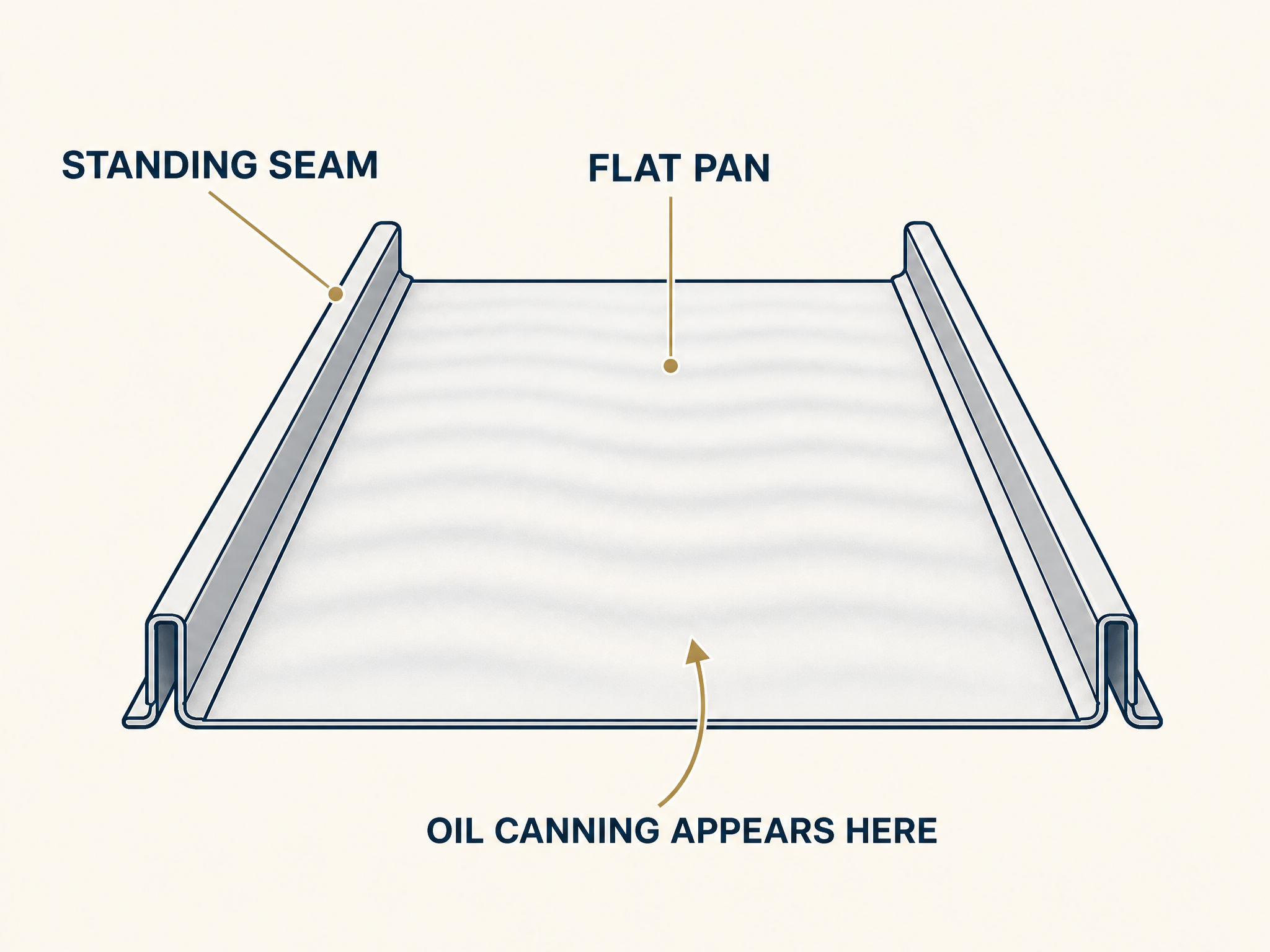
Oil canning is perceived waviness across the broad flat area of a metal panel, called the pan. It is inherent to light-gauge, cold-rolled flat metal.
The phenomenon occurs in every metal used in construction, including steel, Galvalume, galvanized steel, stainless steel, copper, zinc, and aluminum.
Oil canning does not affect the structural integrity of the panel and does not cause leaks.
There is no industry scale for measuring oil canning because its severity is based on appearance rather than a measurable performance failure.
What Does Oil Canning Look Like?
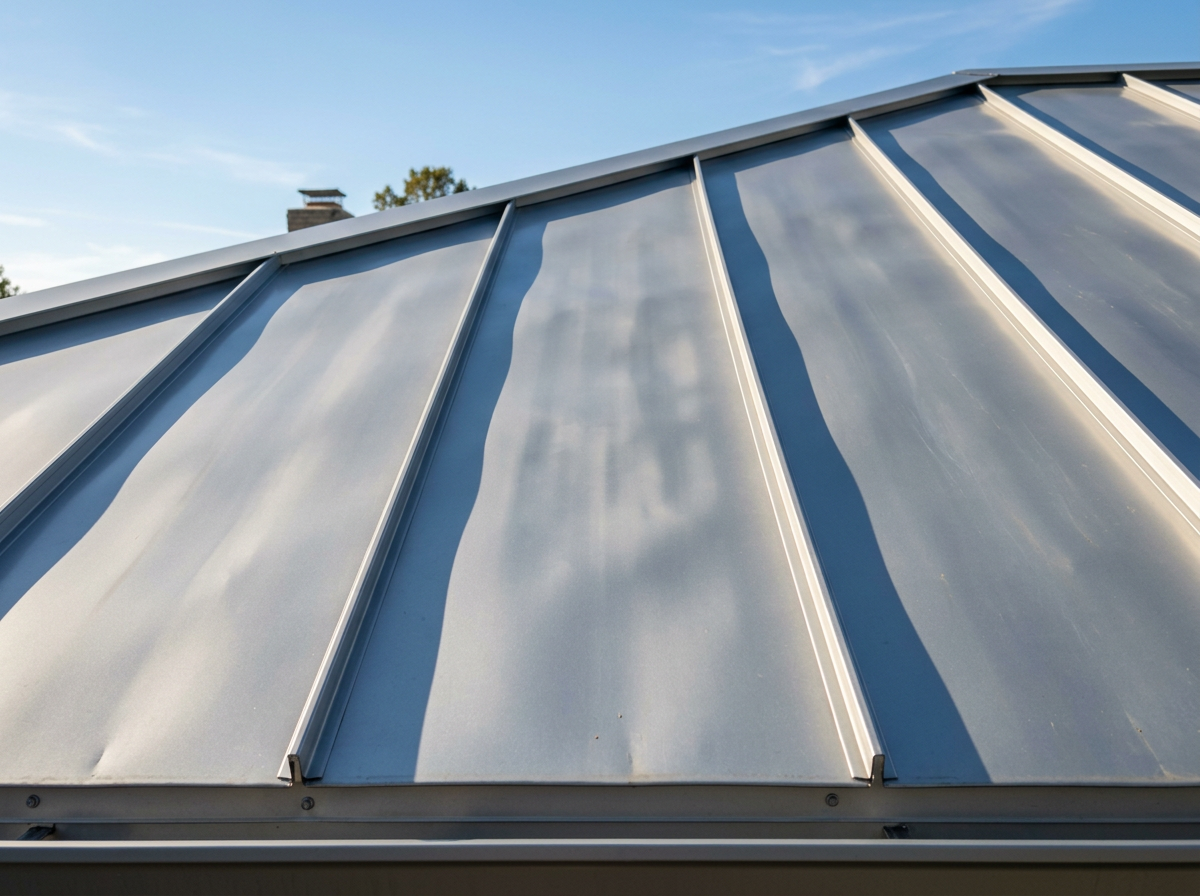
Oil canning looks like shallow waves, ripples, or slight distortions across the broad flat pan of a standing seam metal panel. It is most noticeable when light reflects across the surface at certain angles.
The appearance is not uniform throughout the day. Morning or afternoon sunlight can make the same panel look different from what you see under overcast conditions or from a different position.
Color also changes how easily the waviness catches your eye. Highly reflective surfaces make changes in the panel plane more noticeable, while lower-reflectivity finishes reduce the visual effect.
What Causes Oil Canning?
Oil canning comes from stresses introduced into the metal during production, forming, installation, handling, and movement of the building.
The Metal Construction Association identifies three production conditions that create different types of coil distortion.
Full center occurs when the middle of the coil is longer than the edges, creating ripples.
Wavy edge occurs when one edge of the coil is longer than the other.
Camber occurs when the coil curves away from a straight line when laid flat, similar to a banana.
Roll forming and slitting can add stress because metal has a memory and attempts to return toward its original shape. Installation can add more stress through over-driven or angled fasteners, clips that are too tight or too loose, and panel misalignment from ridge to eave.
The roof also needs room for thermal movement. Double-pinning both edges prevents the panel from moving naturally as it expands and contracts, putting additional stress into the pan.
Other sources include an uneven deck, structural movement after installation, handling that repeatedly twists the panels, and installing panels to dimensions that do not match the roof.
Is Oil Canning a Defect or a Failure?
Oil canning is a cosmetic characteristic of flat metal panels, not a structural defect or roofing failure.
It does not compromise the structural integrity of the metal panel. The roof can remain fully functional while showing visible waviness across the pan.
Because oil canning is cosmetic, its severity is judged by appearance rather than structural performance.
That distinction matters when you are evaluating a metal roof. A visibly wavy panel does not, by itself, indicate that the roofing system has failed.
Does Oil Canning Cause Leaks?
No, oil canning does not cause leaks because it is a cosmetic condition that does not affect the watertight performance of the metal panel.
The waviness occurs in the broad flat portion of the panel and does not create an opening through the metal. A roof with visible oil canning can remain weathertight and perform its intended function.
If a metal roof is leaking, the cause needs to be identified separately. Oil canning itself is not the source of the water intrusion.
Why Do Warranties Exclude Oil Canning?
Oil canning is excluded from metal roofing warranties because it is a cosmetic condition, not a failure of the roofing system.
Weathertightness, substrate, and paint warranties across the industry exclude oil canning from their claims. The exclusion reflects the nature of the condition and is standard warranty language for metal roofing.
Oil canning does not indicate that the panel has lost its structural function or that the roofing system has stopped protecting the building. It addresses appearance rather than performance.
Does Metal Thickness Affect Oil Canning?
Yes, metal thickness affects oil canning because thicker metal is stiffer and resists movement better than thinner metal.
The gauge of the metal changes how readily the flat pan can move under stress. Heavier material provides greater resistance to the movement that produces visible waviness.
We form standing seam panels from 22-gauge and 24-gauge steel. We do not use 26-gauge steel, and we do not warranty 26-gauge.
For a detailed comparison of these steel gauges, see our 24-gauge versus 26-gauge guide.
Does Panel Width Affect Oil Canning?
Yes, panel width affects oil canning because a narrower flat pan has less broad surface area in which visible waviness can develop.
Industry guidance specifies standing seam panel widths of 18 inches or less. Our panels are 16 inches wide.
Panel width is one of several physical characteristics that influence how much waviness is visible across the flat pan. Narrower panels break the roof surface into smaller sections, reducing the visual expanse of each individual pan.
Do Color and Finish Change How Visible Oil Canning Is?
Yes, color and finish change how visible oil canning is because they affect how light reflects from the flat surface of the panel.
The same amount of waviness can look more pronounced in a highly reflective finish and less noticeable in a low-gloss or matte finish. Viewing angle also changes what your eye sees.
This is why oil canning can appear more obvious at one time of day or from one side of the roof than another.
For more information about metal roof color and finish options, see our guide to metal roofing colors and finishes.
Does Oil Canning Get Better Over Time?
Yes, mild oil canning often becomes less noticeable over time as the metal works out stresses over several seasons.
Metal responds to temperature changes and movement after installation. As the panel experiences normal cycles of expansion and contraction, some of the stresses introduced during production, forming, handling, and installation can settle.
Can Oil Canning Be Fixed After the Roof Is Installed?
Oil canning usually cannot be completely removed after a metal roof is installed because the waviness is related to stresses within the metal and the conditions affecting the panel.
The first step is identifying what is creating the visible waviness. An uneven substrate, improper fastening, restricted thermal movement, panel misalignment, or other installation conditions require a different response than cosmetic waviness inherent to the metal itself. See our standing seam installation guide for more information about installation conditions.
When the condition is cosmetic and the roof is otherwise performing properly, replacement of otherwise sound panels is not automatically warranted.
How Do We Reduce Oil Canning on the Roofs We Install?
We reduce oil canning by controlling the panel specifications, substrate, fastening, thermal movement, and panel fit during installation.
We use 22-gauge and 24-gauge steel, 16-inch-wide panels, and a floating clip system that allows the panels to expand and contract. Our panels are formed to the exact roof dimensions so they are not forced into an incorrect fit. See our on-site roll forming process for more information.
Our crew forms each panel to the length of that specific roof run before the panel reaches the deck.
The roof deck also matters. We install over a level, in-plane substrate because an uneven deck can telegraph its shape through the metal panel.
Our heavy-duty clips use two fasteners each, with spacing of 12 inches in the field and 9 inches at the perimeter. Proper clip installation allows the panel to move while keeping the system securely attached. See our guide to standing seam clips and fasteners for more detail.
What Other Questions Should I Ask?
How can I check for oil canning before the panels go on the roof?
You can check for oil canning before installation by inspecting panels both while suspended and loose on the actual deck material.
Pull one or two panels from the bundle and hang them horizontally from the side. Support them along the top rib every 10 to 12 feet and look down the length of the panel for flatness.
Then lay the panels loose on the actual deck material with no fasteners and inspect them again. The first check evaluates the panel itself, while the second shows how the panel interacts with the substrate.
What should you do if you see heavy oil canning during installation?
Stop the installation and determine where the oil canning first appeared before additional panels are installed.
Check whether it was visible in the bundle, appeared after handling, showed up when the panel was loose on the deck, or appeared only after fastening. Where the condition first appears points toward its cause.
Stopping early costs far less than discovering the problem after the roof requires a tear-off.
Can you see oil canning from the ground?
Oil canning often cannot be seen from the ground, or it is visible only under certain conditions.
Much of the oil canning shown in photographs is captured from an elevated position or under raking light that a person standing in the driveway never sees.
The viewing position changes what is visible across the flat pan.
Is oil canning more likely on a re-roof than on new construction?
Oil canning is more dependent on the condition of the deck than whether the project is new construction or a re-roof.
New construction usually starts with a flat, in-plane deck. A re-roof inherits whatever shape the existing deck has, so any bow or dip can telegraph through the metal.
That is why the deck gets inspected before panels go on.
Does oil canning happen on metal siding and wall panels too?
Yes, oil canning also occurs on metal siding and wall panels because they use broad, flat metal surfaces that can develop visible waviness.
It can read more strongly on a wall because walls are usually viewed straight on and at eye level. A roof is typically viewed at an angle and from a greater distance.
Will a home inspector or appraiser flag oil canning?
A home inspector may note oil canning as a cosmetic observation rather than a defect because it does not affect roofing performance.
The condition can appear in an inspection report even when the roof remains structurally sound and watertight.
Knowing the distinction between a cosmetic observation and a performance defect is useful if oil canning comes up during a sale.
What is a tension-leveled metal coil?
A tension-leveled metal coil is material that has been stretched past its yield point so the metal cannot spring back as strongly toward its original shape.
Tension leveling is an industry method used to reduce residual stresses in flat metal. It addresses stresses in the coil before the material becomes a finished roofing panel.
What are striations on a metal roof?
Striations are formed ribs or stiffening patterns placed into the flat portion of a metal panel to break up the visual expanse of the pan.
Common patterns include ribbed, V-rib, bead, pencil, striated, corrugated, and clip relief. These patterns do not eliminate oil canning, but they make the waviness less visually apparent.
What is backer rod used for under metal roofing clips?
Backer rod or shim material can be placed beneath clips over a solid substrate to allow the panel pan to pillow evenly and relieve stress.
This technique is described in Metal Construction Association technical guidance. It is used where the clip and solid substrate interface requires additional accommodation.
What does a floating clip do on a standing seam roof?
A floating clip allows a standing seam panel to move as the metal expands and contracts with temperature changes.
The clip secures the panel while accommodating thermal movement rather than locking the panel completely in place. This allows the roofing system to handle normal dimensional changes without unnecessarily stressing the metal.
Reach Us
If you have questions about oil canning on a metal roof, we can evaluate the roof and explain what you are seeing.
The Metal Roof Pros serves Los Angeles, Orange, Ventura, and Riverside counties. Call (818) 937-4500(818) 937-4500 for a free satellite quote, emailed directly to you with no salesperson.
For more roofing information, visit our Learning Center.